Introduction
A practical overview of KUI and its deployment model.
KUI is an open-source web console for operating Apache Kafka. It brings cluster health, topic administration, record browsing, consumer groups, Schema Registry, Kafka Connect, ksqlDB, and alerts into one workspace.
Start with the real product#
The Docker quickstart starts Kafka, seeded records, a lagging consumer, Schema Registry, Connect, ksqlDB, broker metrics, and KUI. It builds the KUI images locally when they are missing. No separately installed JVM is required for that path.
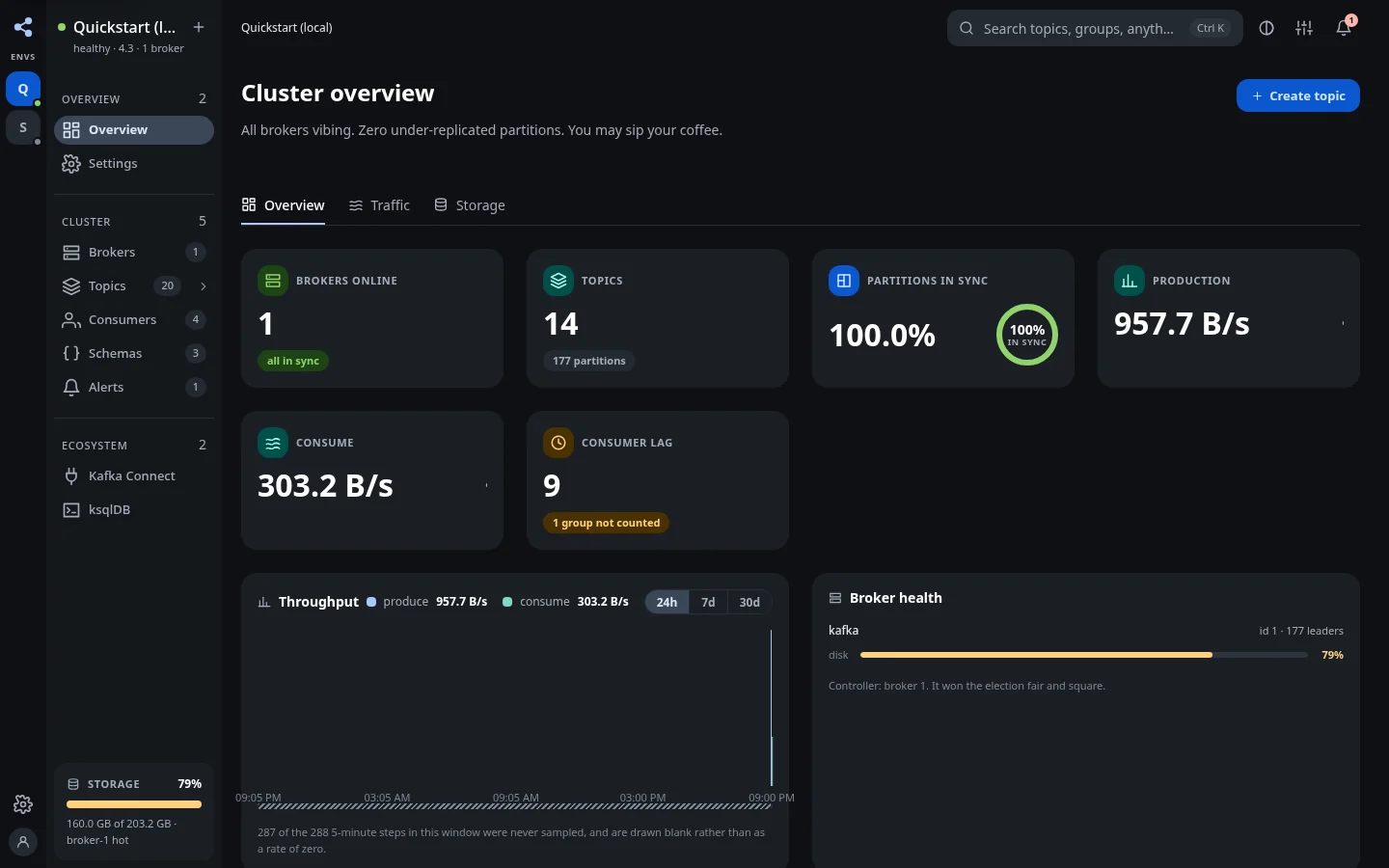
Choose your next step#
| Your goal | Read this guide |
|---|---|
| Try KUI on your machine | Run locally with Docker |
| Find a particular event | Filter records |
| Replay records to another topic | Copy between topics |
| Diagnose lag and reset offsets | Consumer lag & offset plans |
| Ship images to your registry | Build images and publish images |
| Operate a secured deployment | Production deployment |
How KUI runs#
The browser interface is a separate nginx container. It serves /ui/ and proxies same-origin /api/ requests to the backend. The backend can run as one all-in-one process or as a gateway with independent domain services.
The application uses Scala 3, Cats Effect, and FS2 behind a SolidJS interface. Generated TypeScript clients share the published OpenAPI contracts with the backend.
Current scope#
KUI is pre-1.0. This repository builds images from source; it does not provide an official registry publication workflow. Local examples disable authentication. Configure authentication, authorization, secrets, and HTTPS before exposing KUI beyond a trusted local environment.
ACL and client-quota management are outside the current product scope. Optional integrations appear only when configured. Available writes depend on KUI permissions, cluster read-only mode, and the Kafka principal's own permissions.