A workshop that builds instruments — terminal dashboards, air-quality readers, camera
firmware, streaming controllers and the small libraries underneath them. Every
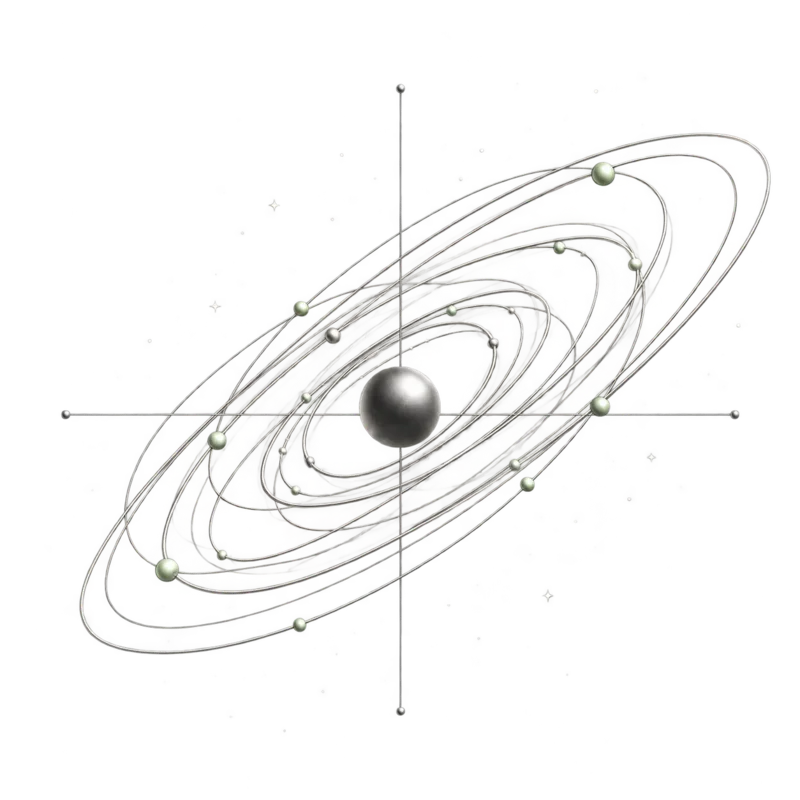
repository below is a star in the sky behind this text.
The catalogue is grouped by subject rather than by language or by account. Each
group is one constellation in the sky, and each link below filters the catalogue
down to it.
◈
Streaming & OBS
Controllers, dashboards and browser overlays for OBS Studio, plus chat clients and
bots for Twitch and YouTube — everything that runs while a live stream is on air.
Ways of reading an AirGradient air-quality monitor: a desktop window, a phone app,
a terminal, a panel icon, an e-paper screen, a wall of LEDs and a metrics stack —
all talking to the sensor on the local network rather than to a cloud account.
Firmware for small Wi-Fi microcontroller boards — cameras, relays, LED panels —
together with the network services on the other end of the wire that receive their
frames and send them commands.
Tools that take a fresh Linux machine, or a homelab of them, and bring it to a
known state from files kept in version control: packages, dotfiles, fonts,
binaries and monitoring.
Libraries and services for the Java Virtual Machine, mostly written in Scala 3 —
API clients, an authentication server, data pipelines and ports of existing
libraries to the Flix language.
Experiments that exist to answer a question rather than to ship a product: a
browser game, an automated writing journal, a webcam filter and other one-off
sketches.
Repositories are split across an organisation and the personal account behind it.
The two logins differ by a single character — an "o" against a zero — so every card
in the catalogue carries a badge saying which one it came from.
worxbendorganisation
The organisation
Tools meant for other people to install and use.
Anything with releases, packages or documentation sits here: the OBS Studio
controllers, the AirGradient clients, the workstation bootstrappers and the Scala
libraries published for other projects to depend on. This repository — the one
serving the page you are reading — is the organisation's profile repository, which
is why it is called .github.
Projects that are still moving, or that are too specific to one desk to be worth
packaging: microcontroller firmware, the homelab infrastructure files, the Flix
ports, the browser game and the daily learning journal. Several of them graduate to
the organisation once they are worth installing.
A quieter third account carrying a small number of newer pieces — a terminal
interface library, a desktop controller for a standing desk, and setup scripts. It
is included here because it is the same person and the same body of work; splitting
it off would only hide things.
The list comes from GitHub, live, with no account and no key. When this
page opens it calls GitHub's public API from your browser — one request per account, no
sign-in, nothing secret — and asks for every public repository on
worxbend, w0rxbend and
oleksandr-balyshyn. Anything pushed to in the last
6 months appears below; forks, archived
repositories and anything with no commits since then are left out. The answer is kept in
this browser for six hours so a reload costs nothing, and the page shows a copy committed
alongside the code while it waits — which is why the catalogue is on screen immediately
rather than after a spinner. The only thing written by hand is the plain-language
description on some cards; every number, language and date is GitHub's.
Loading…
The sky is a real graph, not wallpaper. Every repository in the
catalogue is one point in the WebGL scene behind this text. How large it is comes from
its stargazers and how recently it was pushed; its colour is GitHub's own colour for its
main language; the lines join repositories that sit in the same cluster. Positions come
from a seeded generator, so the sky is identical on every visit — a diagram you can
learn, rather than a screensaver. If the graphics library cannot load, or the browser has
no WebGL, the page adds a plain drifting starfield instead and everything else carries on.
The theme lives in your browser. Picking one of the five swatches in the
bar writes wb.theme to
localStorage — a small key-value store the browser keeps on your
own machine. Nothing is sent anywhere, and a second tab follows along because both tabs
watch the same key. There is no account and no server: this whole site is static files on
GitHub Pages.
Visit analytics never leave this browser. If you allow it, this page
records what it does — a page view, a theme change, a project opened — into IndexedDB, a
database inside your own browser profile. There is no endpoint, no request and no third
party; searches record how many characters you typed and how many results came back, never
the text itself. The panel below is the whole of it: read it, download it as a JSON file,
or delete it. Recording is off until you say otherwise.
Your own visit log
Nothing recorded yet.
—today
The most recent events recorded in this browser
Time
Event
Detail
Nothing has been recorded. Turn recording on above and the events will appear here.